
I was fortunate enough to be part of some projects in Early Childhood Development earlier in my career. Although I’ve always known play was important for learning, I never really paid too much attention to the scientific evidence, until Covid-19 started. I was concerned that our children weren’t getting enough “educational stimulation”, and I needed to reassure myself that they would be ok with few structured activities, and lots of free play. So I started researching Learning through Play (and by researching, I mean I Googled a lot of articles about the topic).
The Lego Foundation released a very interesting white paper on the evidence of Learning through Play. It says that “Children possess an amazing, natural potential to learn… Beyond more obvious areas, such as language development and motor skills, young children also have an imagination and inventiveness that helps them create new ideas and opportunities, and a strong motivation to connect and engage with others.”
According to Their World, play is an important part of a child’s early development. Playing helps young children’s brains to develop and for their language and communication skills to mature. These early childhood games are vital to laying the foundations for formal education. In most cases learning starts with parents or carers engaging with, playing with, and responding to the child. And according to Pentagon Play, play “helps children make sense of the world around them through discovery, allowing them to develop cognitively, socially, emotionally and physically.”
Here are some great resources for learning through play:
The LEGO Foundation
The LEGO Foundation is committed to re-defining play and re-imagining learning to ensure children develop the skills needed to navigate an uncertain and complex world. They have two great resources: Learning to Cope through Play Booklet and the Six Bricks Booklet.
UNICEF
UNICEF, also known as the United Nations Children’s Fund, is a United Nations agency responsible for providing humanitarian and developmental aid to children worldwide. This article, The Science of Play, explores the science behind how you can help your child grow and develop during playful interactions. The Tshwaragano ka Bana – Let’s play, learn and grow together series includes daily routines, playful learning activities and other low-resource/low costs options specifically for South African children.
Play Africa
Play Africa is the first interactive children’s museum in Southern Africa, a groundbreaking social impact initiative creating inclusive and equitable spaces where all children, families and schools can play, create, innovate and connect. They offer online activity packs that can be downloaded: https://playafrica.org.za/activity-packs/
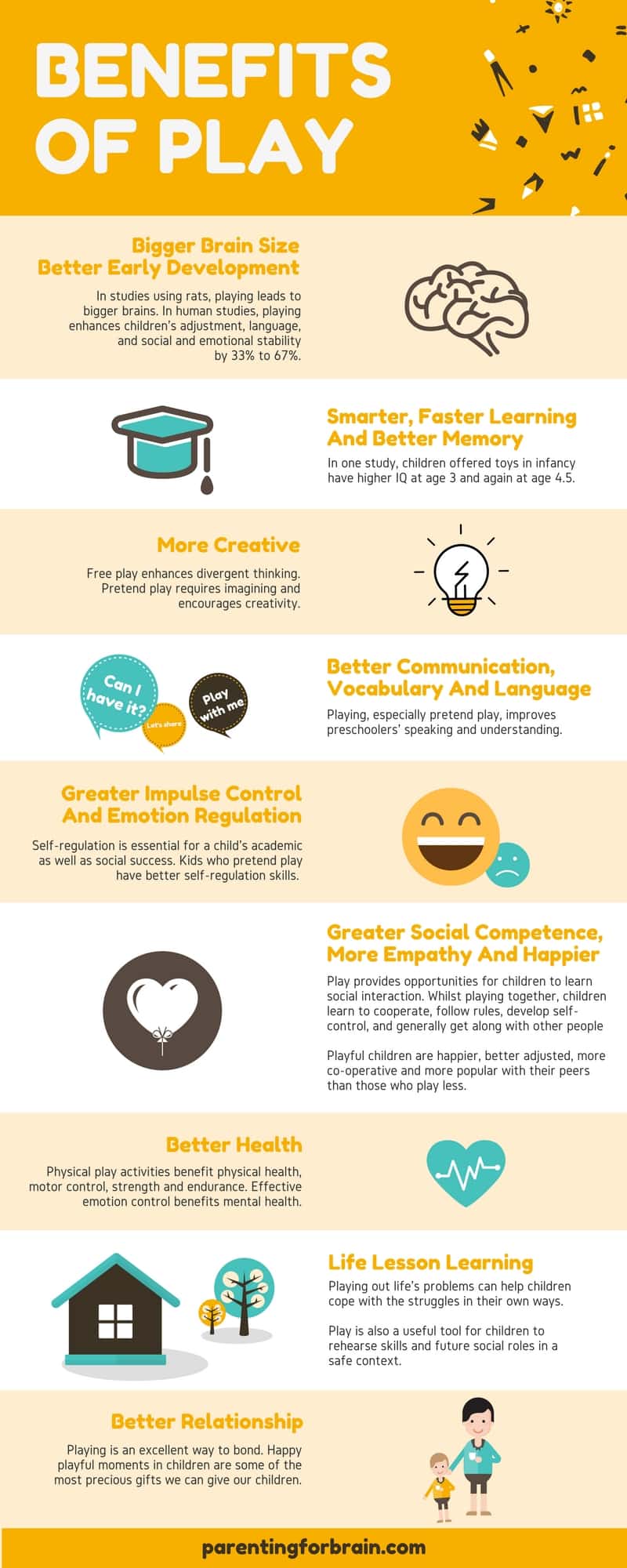
This beautiful infographic by Parenting for Brain shows the 9 benefits of play in early childhood: